
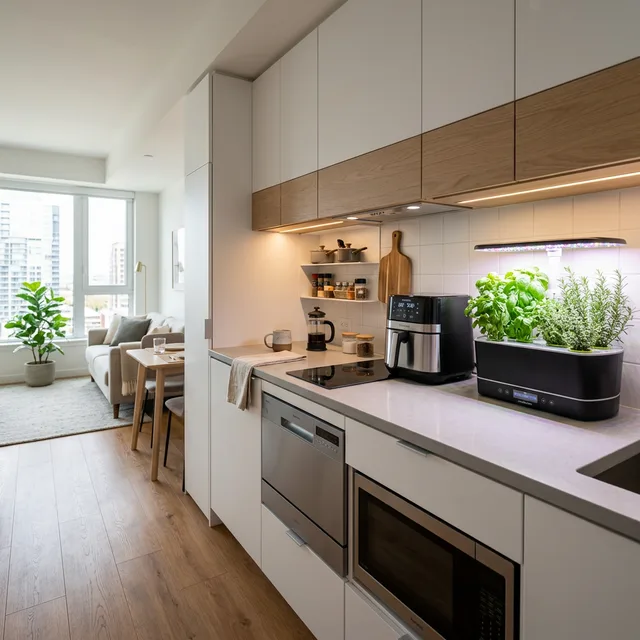
In a studio apartment, your kitchen often exists within a single 2-meter stretch of wall. Every centimeter of counter space is a premium resource that must be shared between food prep, your landing strip valet tray, and perhaps your hidden tech desk. A freestanding kitchen island for an apartment buys back some of that lost counter space without any drilling. To maintain a high-performance urban lifestyle, you cannot afford “Dumb” appliances that do only one thing and take up 30cm of depth. You need a smart kitchen for small apartments—an integrated ecosystem of multi-functional, high-density tools. See the latest smart kitchen gadgets.
The philosophy of an urban kitchen is “Nutrition-to-Volume Ratio.” Since you can’t have a full pantry, you need tech that makes processing fresh ingredients in a small space efficient and zero-waste. By utilizing sensor-driven tools and intentional smart plug hacks, you can turn a “kitchenette” into a professional-grade nutrition hub. In my own managed studio apartment, these 7 gadgets transformed my relationship with food and supported my micro-wellness journey. Automate it with smart plug hacks.
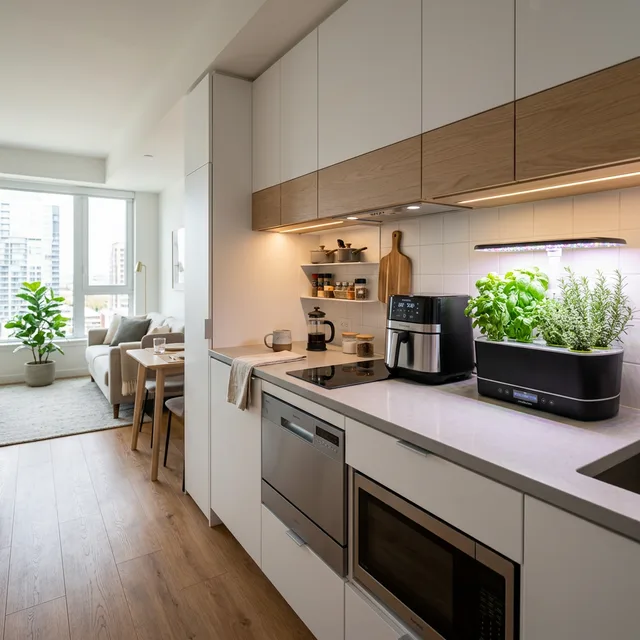
1. The “Vertical-First” Herb Hub
Fresh herbs are the key to high-density nutrition, but buying plastic jars of wilted basil is wasteful. The Tech: Smart Indoor Hydroponic Gardens (like Click and Grow or AeroGarden). The Value: These use “LED Grow Panels” and self-watering reservoirs to grow greens in a 20cm x 15cm footprint. The Integration: This is your indoor-outdoor flow bridge. It provides fresh oxygen to your micro-living air quality and eliminates the need for bulky grocery trips. It’s the ultimate smart kitchen for small apartments hack for the nature-deprived city dweller.
2. The Multi-State “Smart Air Fryer”
In a studio, a full-sized oven heats the entire room, ruining your smart apartment climate control and using massive energy. The Tech: A 4-in-1 Smart Air Fryer (e.g., Ninja Foodi or Cosori Smart). The Function: These units bake, roast, fry, and dehydrate. The Automation: Sync the unit to your digital identity kit. You can pre-heat the air fryer while you are on your urban mobility commute. By the time you walk through your landing strip, you are 10 minutes away from a high-protein dinner. Dial in comfort with smart climate control.
3. Precision “Smart Scales” with Macro-Sync
Eating for performance in the city requires tracking what you consume. The Gear: A Bluetooth-enabled smart nutrition scale. The Routine: As you prep your meal on your high-density kitchen counter, the scale logs the weight and nutritional data directly to your phone. The Benefit: It eliminates the “Mental Accounting” of calorie counting, maintaining your mental clarity for your actual work. It’s a mandatory tool for vertical fitness enthusiasts.
4. The “Induction” Single-Burner (Stealth Stove)
Many studio kitchenettes have slow-to-heat electric coils. The Hack: Use a portable Smart Induction Cooktop (like DuPont or NuWave). The Benefit: It heats up 50% faster than standard coils and stays cool to the touch (safer for urban pets and plants). The Value: When you aren’t cooking, you can store the burner vertically or in a drawer, reclaiming your entire counter for your digital wallet transition organizing or your cloffice work. Cook faster with induction cooking.
5. Vacuum Sealers: The “Bulk-Buying” Logic
In 25sqm, you don’t have room for “Costco-sized” bins. But buying single-servings is expensive and creates visual noise from packaging. The Tech: A compact, rechargeable vacuum sealer. The Strategy: Buy your protein in bulk, portion it out, and vacuum seal. The Routine: This allows you to store “Flat” packages in your managed studio apartment freezer, maximizing volume and ensuring zero freezer burn. It supports your minimalist on a budget financial goals.
6. Scent-Managing “Smart Trash”
In a small one-room living space, the smell of kitchen waste can ruin your sensory sanctuary in minutes. The Tech: An Odor-Neutralizing Smart Bin (like the Townew). The Interaction: It automatically seals the bag and dispenses a new one. The Synergy: This integrates with your smart aromatherapy by removing “Competitive Odors.” It ensures your micro-living air quality remains fresh, which is critical for deep sleep recovery since your bed is likely 2 meters from your trash.
7. The “Smart Plug” Beverage Logic
As detailed in our intentional smart plug hacks, your kettle or coffee maker should be automated. The Routine: The “Pre-Prepped” morning brew. The Value: This saves 5 minutes of standing in a dark kitchen during your 15-minute prep. It turns a “Basic Task” into a “Luxury Experience,” reinforcing the feeling that you are a master of your smart studio apartment setup.
| Gadget Category | Core Function | Space Requirement | [Micro-Wellness](https://urbanmicrotips.com/micro-wellness-habits-studio-living) Gain |
| Nutrition | [Smart Herb Hub](https://urbanmicrotips.com/growing-food-windowless-apartment-guide) | Vertical / Minimal | Fresh Nutrients / Oxygen |
| Cooking | Smart Air Fryer | Medium (Multi-Use) | Time Savings / Cooling |
| Cleanup | Auto-Sealing Bin | Small (Floor) | Air Quality / Scent |
| Privacy | [Induction Burner](https://urbanmicrotips.com/smart-kitchen-small-apartments-gadgets-2026) | Zero (Storable) | Safety / Reclaimed Counter |
Safety Disclaimer
Always ensure your induction cooktop is cool before storing it vertically. Never leave an air fryer unattended while in “Remote Pre-heat” mode if you have loose kitchen textiles nearby. Ensure your smart bin’s batteries are charged to avoid being locked out of your trash bag disposal during a high-activity prep session.
[UPDATE 2026] Smart Kitchen Tools by Footprint and Real Gain
After two years of testing gadgets in a 38 sqm studio, here is what actually stays on the counter versus what ends up in the cabinet after a month:
| Tool | Counter Footprint | Daily Use Frequency | Worth It? |
|---|---|---|---|
| Instant Pot Duo Mini (3qt) | 9×9 in | 3-5x/week | Yes — replaces pot, steamer, slow cooker |
| Compact air fryer (2qt) | 7×8 in | Daily | Yes for singles — replaces oven for most tasks |
| Induction single burner | 11×11 in | Daily | Yes — main cooking surface if stove is electric |
| Smart scale + app | 5×7 in | 3x/week | Yes for meal prep, low footprint |
| Full-size stand mixer | 14×10 in | 1x/month | No — footprint cost too high vs frequency |
| Multi-function blender/cooker | 10×10 in | 2x/week | Depends — only worth it if it replaces 3+ tools |
The rule for micro-kitchens: if a tool sits on the counter, it needs to be used at minimum 3x/week or replace at least two other items. Anything below that threshold earns cabinet space, not counter space — and in a studio, that often means it leaves entirely.
What smart kitchen gadgets save space in a micro-apartment?
Multi-function appliances that replace 2-3 single-purpose tools: an Instant Pot replaces a stock pot, steamer, and slow cooker in a 9×9 inch footprint. A compact air fryer replaces the oven for 80% of tasks in 7×8 inches. A single induction burner replaces a stovetop entirely if your existing stove is low-quality electric. Gadgets that do not earn their footprint in a micro-kitchen: full-size stand mixers, rice cookers (pot on induction works), and any specialty appliance used less than 3x/week.
How do I organize a micro-apartment kitchen with no cabinet space?
Use vertical space before horizontal: magnetic knife strips save a full drawer, wall-mounted spice rails keep the counter clear, and over-the-door organizers on the pantry or fridge side hold small items. Inside cabinets, stackable bins and turntables double effective depth. For counter appliances, use the one-in-one-out rule — every new tool must replace an existing one. The most impactful change in most micro-kitchens is eliminating single-purpose tools entirely.
Is a smart fridge worth it in a small apartment?
No. Smart fridges are 30-36 inches wide and typically 69-70 inches tall — the same footprint as standard models but at a $1,500-$3,000 premium for features that have minimal utility in a studio where you can see the fridge from anywhere in the apartment. The high-value upgrade is a full-size standard fridge over an apartment-size model — storage capacity matters more than smart features.
Most space-efficient cooking setup for a studio apartment?
Single induction burner (11×11 in) plus 3-quart Instant Pot plus compact air fryer (2qt). This combination covers boiling, pressure cooking, slow cooking, steaming, and air frying in roughly 30 inches of combined counter space and handles 95% of weekday cooking for one or two people. Total cost: $100-$180.
