
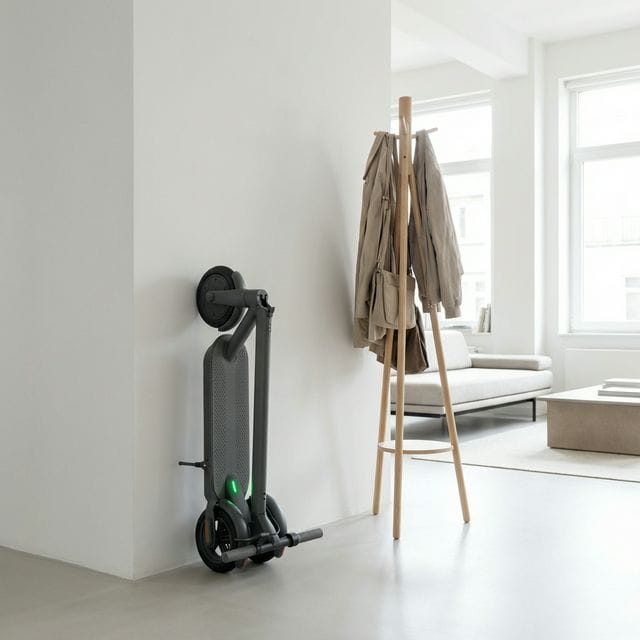
If you live in a 25sqm studio, choosing between an e-scooter vs e-bike for apartment renters isn’t just about speed or range—it’s a high-stakes calculation of spatial geometry. In a micro-flat, your vehicle doesn’t just stay outside; it becomes a piece of furniture that you must store, charge, and maintain within your sensory sanctuary.
The “Urban Mobility” revolution has provided high-performance tools for the city, but it has also created a and infrastructure problem for the modern renter. Do you choose the foldable, ultra-compact scooter that hides under your furniture with legs, or the high-stability e-bike that requires a dedicated vertical bike storage solution? In my own journey of managed studio apartment living, I’ve tested both, and the “winner” depends entirely on your floor plan and your tolerance for visual noise. Store it with foldable e-bike storage.
1. Spatial Footprint: The “Under-Furniture” Rule
The primary advantage of the e-scooter is its ability to “disappear.” Most modern urban scooters (like the Unagi or Xiaomi) can fold down to a height of less than 40cm.
- The E-Scooter: Can be slid under a bed or a sofa if you have furniture with legs for small apartments. This keeps the “visual static” out of your sensory sanctuary studio living area.
- The E-Bike: Even foldable e-bikes have a significant “Width Footprint.” They often take up as much space as a large armchair, even when folded. For a 25sqm studio, an e-bike usually requires a vertical bike storage hook or a dedicated corner near your landing strip.
2. Charging Safety: The “Lithium-Ion Protocol”
Safety is the most overlooked part of e-scooter vs e-bike for apartment renters. In a small room where you sleep, charging a large high-capacity battery requires discipline.
The Habit: Never charge your device overnight or while you are sleeping.
The Tech: Use a smart plug with an automated timer. Program it to shut off after 4 hours. This prevents “Overcharge Heat” and supports your smart security for solo renters goals. Always charge near your air quality purifier to detect any early signs of thermal runaway (unusual odors). Add smart security.
3. Weight and Portability (The Third-Floor Test)
If your building doesn’t have an elevator, the choice between e-scooter vs e-bike is already made for you.
- The Scooter: Most urban models weigh between 12kg and 16kg. This is manageable for a single-flight carry during your urban mobility commute.
- The Bike: Even “lightweight” e-bikes often exceed 20kg. Carrying this up stairs is not part of a healthy micro-wellness routine—it’s a path to back injury. If you have an elevator, this is less of an issue, but consider the “spatial friction” of maneuvering a bike through narrow apartment hallways.
4. Range vs. Terrain: The Biological Cost
An e-bike allows for “Pedal Assist,” meaning you can still get home even if the battery dies. It is superior for hilly cities and longer commutes (10km+).
- The Biological Value: E-bikes provide a low-impact form of vertical fitness for your commute. You arrive at work with your mental clarity intact but having burned calories.
- The E-Scooter: Is strictly a “throttle” vehicle. It’s better for “Last Mile” connectivity—getting you from your small studio apartment to the subway station. It is less stable on wet urban cobblestones, which is a safety variable to consider.
5. Integrating with Your Entryway Landing Strip
Your mobility vehicle is the king of your entryway. It must play nice with your modular EDC system.
- The Hack: Use a “Drip Tray” or a natural fiber rug specifically for your scooter or bike. The city “grime” (oil, rain, dust) must be contained.
- The Routine: As part of your evening reset habit, wipe the tires of your vehicle. This prevents “Urban Dirt” from migrating into your sensory sanctuary, maintaining your micro-living air quality.
6. Stealth Design: Hiding the Tech
In a sensory sanctuary, you don’t want to be reminded of the “industrial city” while you’re relaxing.
The Solution: Use smart textiles for zoning to create a “garage curtain” for your e-bike. If you use a scooter, use a custom-made wooden “Scooter Box” that doubles as a bench on your landing strip. Hiding the “industrial” elements of your urban lifestyle is key to maintaining mental health studio vibes.
7. Security: The “Inside Only” Rule
The best anti-theft strategy is to never leave your vehicle outside. This is why e-scooter vs e-bike for apartment renters is a debate about interior space.
- The Reality: Outside bike thieves are highly sophisticated. In a high-density city, an e-bike left on the street is a target.
- The Integration: Your vehicle should be viewed as part of your digital identity kit—an essential piece of tech that stays within your managed studio apartment. Using a smart lock for your home is your primary defense for your mobility gear.
| Feature | E-Scooter | E-Bike |
|---|---|---|
| Storage | Under-Bed / Hidden | Vertical Wall Mount |
| Weight | 12-16kg (Portative) | 20-25kg (Heavy) |
| Range | 15-25km | 40-70km |
| Stability | Low (Small Wheels) | High (Full Tires) |
| Fitness | Zero (Throttle) | Pedal Assist / High |
Are e-scooter batteries dangerous in small apartments?
Only if they are damaged or ‘off-brand.’ Stick to UL-certified brands and follow our lithium-ion charging safety habits. Keeping your air quality purifier nearby is a good secondary safety measure.
How do I store a bike if I can’t drill into the walls?
Use a ‘Gravity Stand’ or a ‘Pole Stand’ that wedges between the floor and ceiling. This is the renter-friendly studio hack for vertical bike storage.
Which is better for a 20km commute?
Definitely the e-bike. The larger tires and pedal-assist make longer urban journeys much safer and more comfortable for your micro-wellness.
—
