
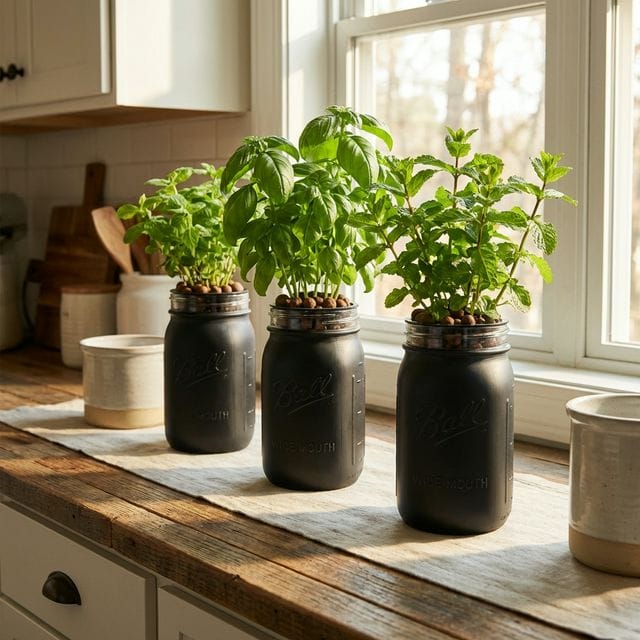
Every potted basil from the supermarket dies within two weeks in an apartment kitchen. The soil dries unevenly, the roots rot in the drainage water, and the plant collapses. The problem isn’t your ability to keep plants alive — it’s soil in a container environment. Fit it into small apartment kitchen ideas.
The Kratky method eliminates soil entirely. Your herbs grow in a glass jar filled with nutrient water. No pumps, no electricity, no drainage trays. A single jar costs under €12 to set up and produces continuous harvests for months. Then see harvesting and storing edibles.
This is the complete setup guide for hydroponic mason jar herb gardens in studio and small apartments — including which herbs work, what kills beginner setups, and the exact steps from jar to first harvest. Try more mason jar herb garden ideas.
Table of Contents
- How the Kratky Method Works
- What You Need and What It Costs
- Step-by-Step Setup Guide
- Best Herbs for Mason Jar Hydroponics
- Maintaining Your Mason Jar Garden
- Troubleshooting: Why It’s Failing
- My Experience: 6 Months of Kitchen Kratky
- FAQ
How the Kratky Method Works {#kratky-method}
In soil, plant roots need both water and oxygen. Fully submerged roots in standing water drown — the oxygen in the water is consumed and not replenished without aeration.
The Kratky method solves this passively. You fill a jar with nutrient solution and suspend the plant in a net cup at the top, with roots barely touching the water surface. As the plant drinks, the water level drops. This creates an air gap between the water surface and the base of the net cup — roots that were submerged become “air roots” that absorb oxygen from the gap, while new “water roots” extend down into the solution.
The plant drinks at exactly the rate it needs more oxygen space. The system self-regulates without any mechanical help.
Why it works better than soil in apartments:
– No soil, no fungus gnats (the most common indoor plant pest)
– No drainage trays accumulating standing water
– Roots have continuous access to nutrients — herbs grow 30–50% faster than soil equivalents
– No watering schedule to manage
What You Need and What It Costs {#what-you-need}
A three-jar starter setup costs €20–€35. Everything is reusable indefinitely.
| Item | Purpose | Cost |
|---|---|---|
| Wide-mouth mason jars (1L) | Main reservoir | €8–€12 for 4-pack |
| 5–6cm net cups | Hold the plant | €4–€6 for 20-pack |
| Clay pebbles (LECA) | Support plant stem | €6–€10 for 2L bag |
| Liquid hydroponic nutrients | Feed the plant | €10–€15 per bottle (lasts months) |
| Black tape or matte black spray paint | Block light, prevent algae | €2–€5 |
| LED grow light (optional) | For windowless kitchens | €12–€25 |
The item most people skip and regret: light-proofing material. If light hits the nutrient solution inside a clear glass jar, algae blooms within two weeks. The algae consumes dissolved oxygen and kills the roots. Light-proofing is not optional.
Step-by-Step Setup Guide {#setup-guide}
Step 1: Light-proof the jar
Wrap the outside of the mason jar completely with black tape, or coat the exterior with matte black spray paint. Leave a thin 5mm vertical strip unwrapped/unpainted to check the water level without opening the jar. The inside must be in complete darkness.
Step 2: Mix the nutrient solution
Follow the instructions on your hydroponic nutrient bottle. As a starting point: 2–3ml of liquid nutrient concentrate per litre of water at half the recommended strength. Full-strength nutrients can burn seedling roots. Fill the light-proofed jar to 3–4cm below the rim.
Step 3: Prepare the plant
Buy a supermarket herb pot (basil or mint are the easiest starts). Remove from the pot and wash all soil from the roots under lukewarm running water. Roots must be completely clean — any remaining soil rots in the water. The roots should be white or pale cream colour.
Step 4: Assemble
Thread the clean roots through the bottom of the net cup. The roots should hang freely below. Place the net cup in the jar opening — the very tips of the roots (or the bottom 5–10mm) should touch the nutrient solution surface. Fill the net cup with rinsed clay pebbles to support the stem upright.
Step 5: Place and light
Put the jar on a south or west-facing windowsill with at least 4–6 hours of direct sun. For north-facing or windowless kitchens: a basic LED grow light suspended 15–20cm above the jar for 12 hours per day is sufficient for mint, lettuce, and chives. Basil needs 14 hours.
Best Herbs for Mason Jar Hydroponics {#best-herbs}
| Herb | Light Needed | First Harvest | Difficulty |
|---|---|---|---|
| Mint | 3–4h indirect | 2–3 weeks | Very easy |
| Basil | 6h+ direct | 3–4 weeks | Easy |
| Chives | 3–4h indirect | 4–5 weeks | Easy |
| Cilantro/Coriander | 4–5h | 3 weeks | Easy (harvest fast before bolting) |
| Lettuce (loose leaf) | 3h indirect | 2–3 weeks | Easy |
| Parsley | 4–5h | 5–7 weeks | Medium |
| Rosemary/Thyme | Very high | 8–12 weeks | Hard — avoid |
Avoid woody herbs (rosemary, thyme) in Kratky jars. They grow slowly in water, prefer dry conditions, and frequently develop root rot. Use small terracotta pots for woody herbs instead.
Mint is the beginner’s herb. It grows aggressively in water, tolerates lower light than basil, and practically cannot be killed. One mint jar on an east-facing windowsill produces more mint than most kitchens can use.
Maintaining Your Mason Jar Garden {#maintenance}
The refill rule: Never top the jar back to the rim. When water drops to the bottom 2–3cm, add fresh nutrient solution back to halfway up the jar — not to the top. The air gap created by drinking-down must be preserved. Overfilling drowns the air roots and kills the plant within 3–4 days.
Full clean and refill: Every 4–6 weeks, empty the jar, rinse with hot water and dish soap (not bleach — residue kills roots), and refill with fresh nutrient solution. This prevents nutrient salt build-up and bacterial growth.
Harvesting: For basil, always cut from the top, leaving at least 2 node pairs on the plant. Never remove more than one-third of the plant at a time. Regular harvesting prevents the plant from flowering (bolting) — once basil flowers, leaf production slows and flavour degrades. Pinch off any flower buds immediately.
For mint and chives: cut stems back to 3–4cm above the net cup. They regrow within 7–10 days.
Troubleshooting: Why It’s Failing {#troubleshooting}
Green slime in the water: Algae bloom from light exposure. You didn’t fully block the light — wrap the entire jar again, including the top edge around the net cup. Change the water immediately and rinse roots gently.
Plant wilting despite full water: Overfilled jar. Air roots are submerged. Remove half the water immediately. The plant recovers within 24 hours if you act fast.
Brown, slimy roots: Root rot. Caused by warm water (above 24°C), algae consuming dissolved oxygen, or bacterial infection. Clean everything with a 1% hydrogen peroxide solution (1 part H2O2 to 99 parts water), refill with fresh nutrient solution, move to a cooler location.
Yellow leaves, slow growth: Nutrient deficiency, or wrong nutrient type. Soil fertilisers do not work — they lack the mineral balance hydroponic plants need. Use only liquid nutrients labelled for hydroponics. Also check water temperature: above 24°C, water holds less dissolved oxygen, stunting growth.
Bad smell from the jar: Stagnant nutrient water. Full clean and refill required. Should be done every 4–6 weeks regardless.
My Experience: 6 Months of Kitchen Kratky {#my-experience}
I started a three-jar Kratky setup in my studio kitchen in November 2024 — one jar each for basil, mint, and loose-leaf lettuce. The kitchen has a single west-facing window that gets about 3 hours of afternoon sun, so I added a €14 LED grow strip suspended above the counter at 20cm.
What worked immediately: Mint in the first week showed visible root growth through the net cup. By week two, new leaves were coming faster than I could use them. Three months in, the roots have colonised the entire jar and the plant is the most productive thing in my kitchen.
What I got wrong: Basil in the first jar died at week three. I traced it back to the jar not being fully light-proofed — I’d left a gap where the net cup met the jar rim. Algae bloom, oxygen depletion, root rot. The second basil jar was sealed completely and is now on week 14 with no issues.
What surprised me most: The complete absence of fungus gnats. I’d had persistent gnat problems with soil-based herbs before. Zero gnats with the hydroponic setup — nothing for larvae to live in.
Monthly yield after establishment: approximately 60g basil (more than enough for all cooking), continuous mint (I’ve stopped buying mint entirely), and one complete lettuce harvest every 3 weeks.
For larger-scale indoor food growing, see our guide on growing food in a windowless apartment with grow lights and the complete balcony herb garden guide.
Safety Disclaimer
Hydroponic nutrients contain concentrated mineral salts. Store out of reach of children. Do not use near open food preparation surfaces without rinsing hands after handling. If using hydrogen peroxide for root rot treatment, use only 3% pharmaceutical grade or lower — higher concentrations damage roots and eyes. Work with rubber gloves. Dispose of old nutrient solution down a drain with plenty of water — do not pour concentrated nutrient solution into houseplant soil as it will cause salt burn.
FAQ
What is mason jar hydroponics?
Mason jar hydroponics (Kratky method) grows herbs in glass jars of nutrient water instead of soil. The plant sits in a net cup at the jar mouth; roots extend into the solution below. As the plant drinks, a self-maintaining air gap forms. No pumps, no timers, no electricity required. Setup cost: under €12 per jar. First harvest: 2–4 weeks.
Do I need to check pH in a mason jar setup?
For basil and mint, tap water with standard hydroponic nutrients naturally buffers to an acceptable pH range. pH testing is unnecessary for these herbs. If growing lettuce or cilantro and seeing persistent yellowing despite correct nutrients, check pH (target 5.5–6.5) — but this is rarely the issue in a basic kitchen setup.
Can I do Kratky without a grow light?
Yes, if your windowsill gets 4–6 hours of direct sun. South or west-facing windows work without supplemental light for most herbs. North-facing windows or interior kitchens need a basic LED grow strip for 12–14 hours per day.
How often do I change the water?
You top up rather than fully change. When water drops to the bottom 2–3cm, add fresh nutrient solution back to halfway. Do a full clean and refill every 4–6 weeks.
Can I start from seed instead of buying a plant?
Yes, but germinate in a small rockwool cube first. Seeds fall through LECA pebbles. Once the seedling has roots 2–3cm long in the rockwool, place the cube directly into the net cup and pack LECA around it. Add 7–10 days to the timeline versus using a supermarket seedling.
Why are rosemary and thyme not recommended?
Woody herbs evolved in dry Mediterranean conditions — they prefer dry-wet cycles rather than constant water access. In continuous Kratky nutrient solution, they commonly develop root rot and grow slowly. Use small terracotta pots with fast-draining sandy mix for rosemary and thyme.
