
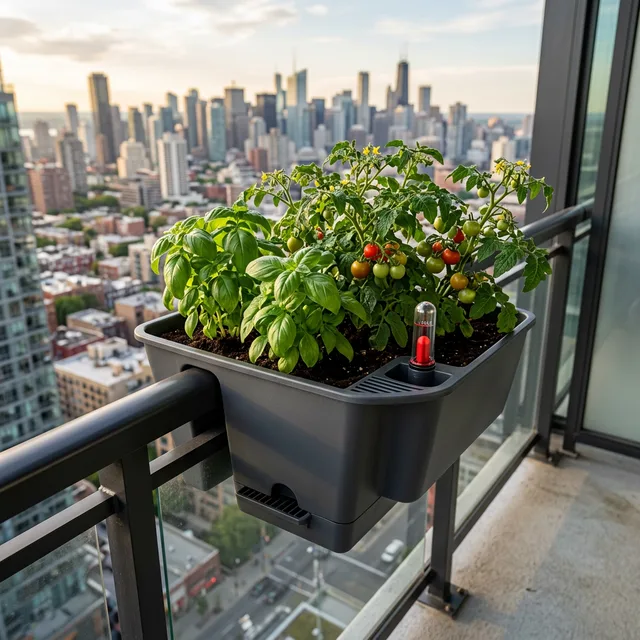
The biggest hurdle for most urban balcony gardeners isn’t the lack of space or light—it’s the lack of a water outlet. Hauling heavy watering cans through your living room every morning is exhausting and often leads to messy spills. If you’re a renter with a high-rise balcony, you likely don’t have a faucet outside. For the full setup, see our balcony gardening hub.
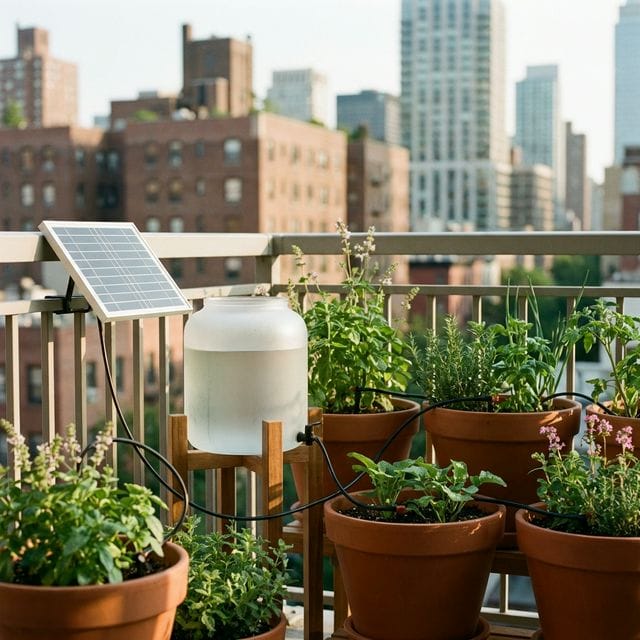
The solution is an automated drip irrigation system for balconies without a faucet. By using a simple reservoir and a low-voltage pump (often solar-powered), you can keep your plants hydrated even when you’re away, without needing a permanent plumbing connection.
How Does Drip Irrigation Work Without a Faucet?
Drip irrigation without a faucet works by drawing water from a static reservoir (like a large bucket or decorative bin) using a small electric or solar-powered pump. The pump is controlled by a timer that sends water through thin tubing directly to the base of each plant at scheduled intervals. This “closed-loop” system is perfect for renters because it requires zero permanent modifications to the building’s plumbing.
3 Best Renter-Friendly Irrigation Systems
1. Solar-Powered Pump Systems (Best for High-Sun Balconies)
These are the ultimate “set and forget” solutions. A small solar panel charges an internal battery which powers a pump. You place the pump’s inlet hose into a 5-10 gallon water reservoir. It’s completely wireless and triggers automatically based on your settings.
2. Indoor/Outdoor Plug-In Timers
If you have an outdoor power outlet, you can use a standard AC-powered pump. These are often more powerful and can support more pots (20+) than smaller solar versions. They are highly reliable but require a safe power source.
3. Gravity-Fed & Wicking Systems
For small setups (3-5 pots), you can elevate a water container and use siphoning or cotton wicks to pull water down. This is silent and electricity-free but harder to control precisely. See our Self-Watering Hacks guide for more on this method.
Step-by-Step: Setting Up Your Reservoir System
- Choose Your Reservoir: Use a 5-gallon food-grade bucket or a decorative storage bin with a lid (to prevent algae and mosquitoes).
- Place the Pump: Most balcony kits come with a pump that clips onto the side of the reservoir or sits on top.
- Run the Main Line: Lay the 1/4″ tubing along the back of your pots or zip-tie it to your balcony trellis.
- Insert Drippers: Use a “T-connector” at each pot to attach a small piece of tubing ending in a drip spike pushed into the soil.
- Test & Adjust: Run the system manually for 1 minute to ensure every pot is getting water and there are no leaks.
Crucial Safety Tips for High-Rise Balconies
- Weight Management: A 10-gallon water tank weighs about 83 lbs. Ensure your balcony can handle this concentrated load by checking our Balcony Plant Calculator.
- Overflow Prevention: Always place your reservoir inside a secondary shallow tray. If a hose leaks or the pump fails “on,” you want a buffer to prevent water from dripping onto neighbors’ balconies.
- Sun Protection: Use black or dark-colored tubing. Clear tubes will grow algae under the sun, which eventually clogs your drippers.
Q: How long will a 5-gallon reservoir last?
For 10 small pots watered for 1 minute twice a day, a 5-gallon reservoir usually lasts 7-10 days. This makes it perfect for a week-long vacation.
Q: Will my neighbors complain about the pump noise?
Solar and high-quality electric pumps are very quiet—usually a low hum that is quieter than a window AC unit. Most people won’t even notice it’s running.
How long will a 5-gallon water reservoir last for balcony plants?
For 10 small pots watered for 1 minute twice a day, 5 gallons usually lasts 7-10 days, making it ideal for a week-long vacation.
Do I need a pump for a balcony drip irrigation system?
If your reservoir is elevated above the plants, you can use gravity. For most balcony setups, a small battery-powered solar pump is the easiest no-faucet solution.
Read more: Explore our Complete Balcony Gardening Hub for more infrastructure tips.
