
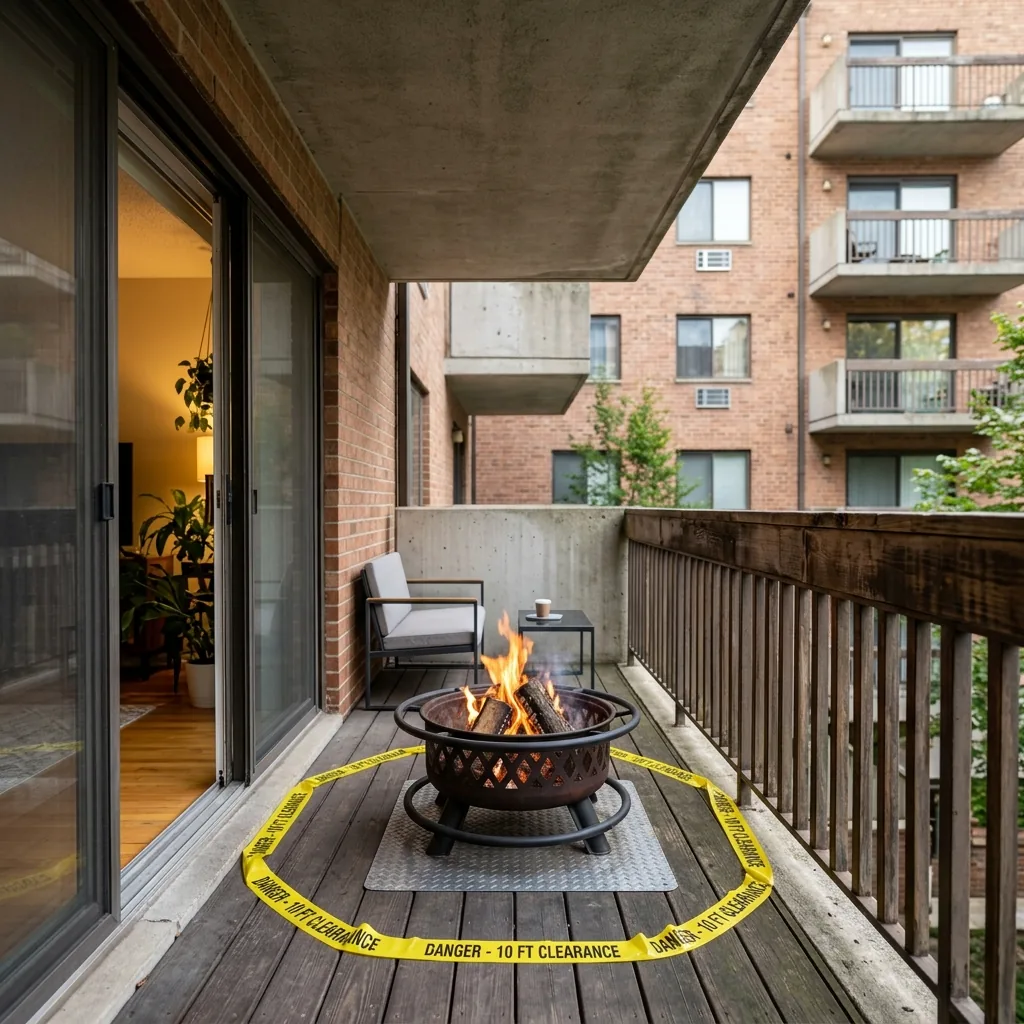
Bioethanol vs propane fire pit for a balcony is the comparison most renter guides skip — they just say “both are open flame, both are banned, get electric.” That’s partially correct. But the legal reality, the actual fire risk, and the practical difference between these two fuel types matter if you’re trying to make an informed decision rather than just following a blanket prohibition. For the wider setup, see our balcony gardening hub.
Short version: both are open-flame devices and both are prohibited on apartment balconies in most US cities. But the reasons differ, the risk profiles differ, and the exceptions differ. Here is the complete picture.
Table of Contents
- What the Law Actually Says
- Bioethanol vs Propane: The Actual Differences
- Comparison Table: Both vs Electric
- Why Most Renters Choose Electric Instead
- FAQ
What the Law Actually Says
Both bioethanol and propane fire pits produce an open flame. Under the International Fire Code (IFC) Section 315.3 and most municipal fire codes adopted from it, open-flame devices on balconies, decks, and similar elevated residential structures are restricted or prohibited.
The specific language varies by city:
New York City: NYC Administrative Code Section 29-20 prohibits burning solid fuel (wood, charcoal) and open flame fuels in residential buildings. Propane tanks above 1 lb are prohibited in apartment buildings. Bioethanol is treated as an open-flame device under fire code.
California (Los Angeles, San Francisco): California Fire Code Section 308.1 restricts open flames in locations where they pose a fire hazard. Most California cities have interpreted apartment balconies as covered locations. Cal Fire has issued explicit guidance treating bioethanol as an open-flame device.
Chicago: Chicago Fire Prevention Code Section 4-60-080 restricts portable open-flame heating devices in multifamily residential buildings. Both bioethanol and propane fall under this restriction.
Texas and Florida: Less restrictive at the state level, but most large cities (Dallas, Austin, Miami, Orlando) have local fire codes that restrict open flame devices on residential balconies, particularly in buildings above 3 stories.
The lease layer: even where local fire code doesn’t explicitly ban your specific device, your lease likely has language about “open flame,” “combustion devices,” or “fire hazards” that covers both propane and bioethanol. Lease violations carry deposit risk regardless of city ordinance.
For the full city-by-city breakdown, see the balcony fire pit rules for renters guide.
Bioethanol vs Propane: The Actual Differences
Fuel Storage and Handling
Propane requires storing a pressurized tank on the balcony. Standard tabletop fire pits use 1 lb cylinders; fire pit tables use the standard 20 lb grill tank. NYC explicitly prohibits propane tanks above 1 lb in apartment buildings. A 20 lb propane tank on a 4th-floor balcony is a significant fire and structural hazard if something goes wrong — the tank can vent, the flame can blow back, and the fuel is heavier than air and can collect in low spots. If you want smaller, see our mini tabletop fire pit picks.
Bioethanol is stored as a liquid in small containers — typically 0.5–1.5 liters in the fire bowl or burner insert. No pressurization. The spill risk (pouring fuel into a hot burner) is the primary safety concern, not stored pressure.
Risk profile: propane is higher-risk in storage and under pressure; bioethanol is higher-risk at pour-time.
Flame Behavior
Propane produces a regulated, consistent flame controlled by a valve. You can modulate intensity. The flame extinguishes when the valve closes. It produces water vapor and CO2 as combustion byproducts.
Bioethanol produces a less predictable flame. It burns cleanly (minimal soot, no smoke in still conditions) but the flame is harder to extinguish quickly — you need a snuffer or wait for the fuel to burn out. In wind, bioethanol flames can be pushed sideways unpredictably. In strong wind, there is a genuine risk of fuel spray from the open burner.
In wind conditions (which all balconies have to some degree): propane is more controllable because the fuel is always in the tank under pressure; bioethanol is in an open dish that can physically splash.
Heat and Ambience
Propane produces substantially more heat than bioethanol. A 40,000 BTU propane fire table will meaningfully warm a 5×8 ft balcony on a 50°F evening. Bioethanol fire pits at tabletop scale typically produce 6,000–12,000 BTU — visible flame, minimal warmth.
If warmth is the goal, propane wins by a large margin.
If ambience (visible flame) is the goal, bioethanol is often preferred because the flame appearance from clean-burning ethanol is more natural-looking than the blue-yellow propane flame.
Legal Standing
Neither is “legal” in the sense of being unrestricted on apartment balconies in most US cities. But there are distinctions:
- Propane is explicitly prohibited by name in more fire codes than bioethanol, and the storage restriction (pressurized tanks in residential buildings) creates a separate legal issue from the flame itself.
- Bioethanol is typically prohibited as an “open-flame device” rather than by name — which means it’s sometimes misunderstood as legal when it isn’t. The classification as open flame is consistent regardless of the fuel’s “clean burning” marketing.
Neither is a safe choice for a renter in a city apartment who values their deposit and wants to avoid a lease violation notice.
Comparison Table: Both vs Electric
| Factor | Bioethanol | Propane | Electric (LED/Vapor) |
|---|---|---|---|
| Open flame | Yes | Yes | No |
| Legal on apartment balcony | No (most cities) | No (most cities) | Yes |
| Lease risk | High | High | None |
| Heat output | Low (6-12K BTU) | High (20-50K BTU) | None to moderate (if heater included) |
| Flame realism | High | High | Low-Medium |
| Fuel cost per use | $1-3/hour | $0.50-2/hour | $0.02-0.05/hour (electricity) |
| Setup | Pour fuel | Connect tank | Plug in |
| Smell | Slight ethanol | Slight gas | None |
| Wind behavior | Unpredictable | Controllable | Unaffected |
| Storage concern | Liquid fuel | Pressurized tank | None |
Why Most Renters Choose Electric Instead
Not because electric fire pits are as impressive as real flames. They’re not, from close up. But the calculation for a renter is different from a homeowner:
Deposit risk. A single lease violation notice in a building with strict management can cost $200–$500 in fines or deposit deductions. A building fire event that traces back to your balcony is financially catastrophic. An electric fire pit creates zero of this risk.
Legal simplicity. An electric fire pit running on a standard 110V outlet is legally equivalent to a lamp. You do not need to understand fire code nuance, local variations, or lease language. It’s simply not an open-flame device.
Improving realism. The best electric units — particularly Dimplex Opti-Myst water vapor technology — produce a flame effect that most people cannot identify as artificial from 6–8 feet in low light. At arm’s length during the day, it’s obviously not real. At dinner table distance after dark, guests consistently fail to identify it.
The full breakdown of electric options is in the electric fire pit for apartment balcony guide.
