
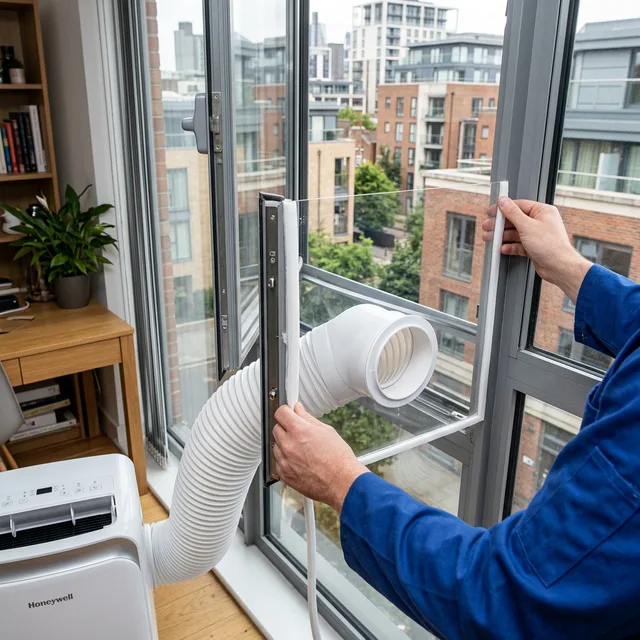
Last June, I moved into a stunning heritage apartment with 10-foot ceilings and original casement windows. My joy lasted exactly three days until the first 90-degree heatwave hit. My landlord’s “No Window Units” policy wasn’t just a suggestion; it was enforced by the local historical society. I had a portable AC, but it came with a standard sliding window kit that was completely useless for my side-opening casement windows. Compare portable AC units.
If you don’t know how to vent a portable ac correctly, your expensive cooling machine becomes a noisy 70-pound paperweight. You can’t just stick the hose out the window and hope for the best; the hot air will circle right back inside, and your electricity bill will look like a phone number. Or cool without AC.
Why trust this guide? I once tried to duct-tape a cardboard box to my window frame to hold an exhaust hose. It rained, the cardboard turned into mush, and my expensive hardwood floor was ruined in under 20 minutes. I have since professionally hacked every type of window from Manhattan sliders to European tilts.
Materials & Tools Needed
| Item | Approx Cost ($) | DIY Time |
|---|---|---|
| Plexiglass Sheet (Custom Cut) | $35 – $60 | 30 Mins |
| Fabric Window Seal Kit | $20 – $30 | 15 Mins |
| Adhesive Foam Weather Stripping | $12 | 10 Mins |
| Reflective Hose Insulation | $15 | 5 Mins |
| Secondary Window Locks | $8 | 2 Mins |
Assess Your Urban Space (Preparation Phase)
Before you buy a single roll of tape, look at your window. In micro-apartments, we aren’t just dealing with heat; we are dealing with security and street noise. If you leave a window partially open to vent your AC, you are inviting burglars and the 76-decibel roar of the city.
Measure the internal track of your window, not just the glass. Most portable units come with kits for horizontal or vertical sliders. If you have casement (swing-out), awning (tilt-up), or sliding glass doors, the default kit is trash. You need a specialized seal that matches the way your window opens.
Step-by-Step Execution: The Ultimate Renter-Safe Install
Step 1: Choose Your Seal Strategy
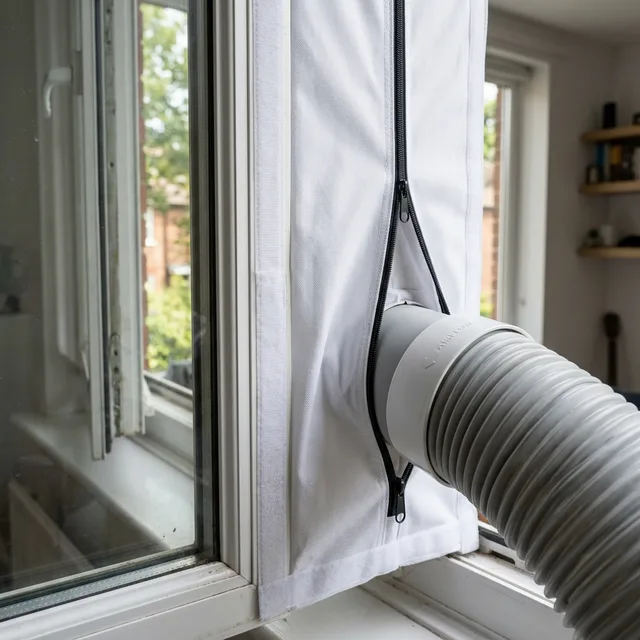
Depending on your window, you have three professional-grade choices. For standard sliders, use the plastic slider kit but seal the gaps with foam. For casement windows, buy a fabric window seal kit with a heavy-duty zipper.
If you want the “Elite Renter” look, go for the Plexiglass Hack. This involves replacing the window screen or fitting a clear plastic sheet into the track with a pre-cut hole for the hose. It lets the light in while keeping the hot air and noise out.
- Micro-Fail Warning: Do not use standard duct tape on painted window frames. The summer heat will bake the adhesive into the wood, and you will lose your security deposit when you peel the paint off in September.
Step 2: Prepare the Window Track with Weather Stripping
Clean the window track with a damp cloth. Dust and city soot will prevent any adhesive from sticking. Apply adhesive foam weather stripping along the frame where the vent kit or plexiglass will sit. This creates an airtight seal that prevents “back-drafting,” where hot air is sucked back into your cool room through tiny cracks.
Step 3: Install the Vent Kit and Secure the Hose
Fit your chosen kit into the window. If using a fabric seal, apply the Velcro strips to the frame first. If using the plastic slider, expand it until it fits snugly against both sides of the frame. Insert the exhaust hose and rotate it clockwise into the adapter until it clicks.
- Pro-Tip Checklist:
- Keep the hose as short as possible (under 3 feet).
- Avoid sharp 90-degree bends which restrict airflow and strain the compressor.
- Double-check that the hose is actually locked; a loose hose can pop out at 3 AM.
Step 4: Insulate the “Radiator” (The Hose)
The exhaust hose of a portable AC can reach 120 degrees Fahrenheit. In a 200-sq-ft studio, that hose acts like a giant radiator heating your room while the AC tries to cool it. Wrap the hose in a reflective silver sleeve (bubble insulation). This can drop the ambient temperature of the hose surface by 15 degrees, making your unit 20% more efficient.
Step 5: Final Security Check
Since your window is now “open,” you’ve bypassed your primary lock. Use a secondary sliding window lock or a wooden dowel cut to the exact length of the remaining track. This prevents anyone from sliding the window open from the outside.
How do you vent a portable AC through a casement window?
To vent a portable AC through a casement window, you must use a fabric window seal kit specifically designed for swing-out or crank windows. First, apply the provided adhesive-backed Velcro tape around the entire perimeter of both the window frame and the edge of the window itself. Next, attach the waterproof fabric seal to the Velcro, creating a “tent” between the open window and the frame. Unzip the center hole, slide the portable AC exhaust hose through, and zip it tight around the hose to create an airtight barrier. This method is 100% renter-friendly because it requires no drilling and can be removed without a trace. For high-rise apartments, ensure the Velcro is heavy-duty to withstand wind pressure that can otherwise pull the seal loose during heavy summer storms.
Common Mistakes & Course Correction
- Venting into a hallway or another room. Never do this. All you are doing is moving heat from one part of the apartment to another, and the compressor will eventually overheat and shut down. ACs must vent to the exterior.
- Using a screen as a seal. Screens are porous. If you just point the hose at a window screen, 40% of the hot exhaust will blow right back into the room. Always use a solid barrier (plastic, fabric, or plexiglass).
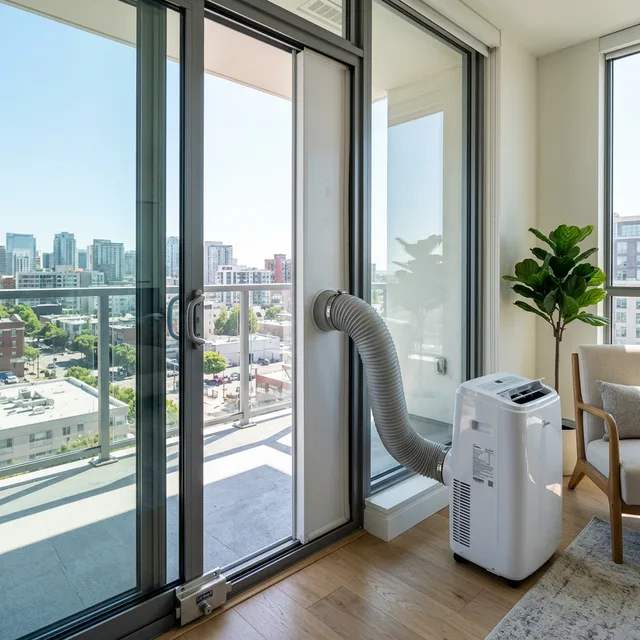
- Ignoring the Balcony Door. If your only window is a giant sliding glass door, don’t despair. You can buy tall sliding door kits that are 80 inches high and fit perfectly into the door track.
Conclusion
Venting your AC isn’t just about sticking a tube out a hole; it’s about building a temporary, airtight thermal barrier. Whether you use a zippered fabric seal for your casement windows or my favorite plexiglass hack, the goal is the same: keep the cold in and the city out.
Measure twice, seal once, and stop sleeping in an oven.
Safety Disclaimer
Always ensure your portable AC is plugged directly into a wall outlet to prevent electrical fires. Periodically check the window seal for gaps or leaks—improper venting can lead to condensation buildup which can cause mold growth on window sills or damage to drywall.
